Dictadoc

Speech and language therapy

Voice dictation for speech and language therapists

Dictate the assessment report through the day, between two patients, then paste it into your word processor with its paragraphs. Everything is transcribed on your computer, and nothing goes through a cloud.

  • Speech sounds
  • Language
  • Stammering
  • Voice
  • Dysphagia
  • Aphasia
  • Progressive neurological conditions
  • Social communication

€19.99 a year, with no automatic renewal.

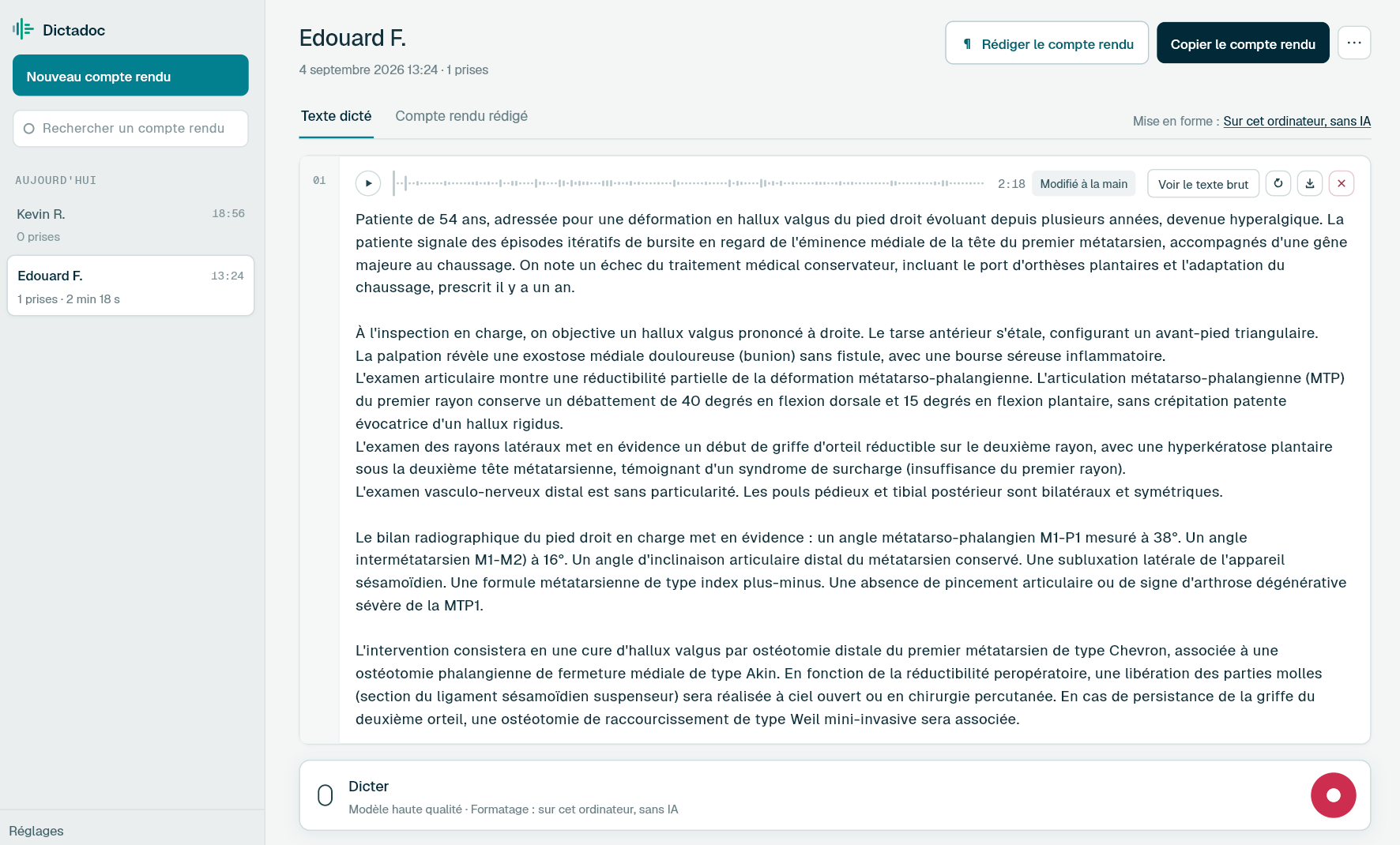
Dictadoc, a report and its recording

Your documents

The writing around your therapy sessions

Most of your day is spent in sessions, and the writing fits around them. The longest documents are also the ones other people read: the GP, the family, sometimes the school.

  • Initial assessment report

    Case history, assessments used, results, clinical impressions and recommendations. Several pages for one patient, written after one or two assessment sessions, and read by the referrer as closely as by the family.

  • Review and progress reports

    What has changed since the last report, what is still difficult and what you propose next. Shorter than the initial report, it repeats the same assessments and compares the results one by one.

  • Session notes

    What you worked on, what went well, what to pick up next time. A few lines after each patient, written in the minutes between sessions, when there are any.

  • Letters to other professionals

    To the GP, ENT, neurology, an occupational therapist or the school: a question, an update, an onward referral. Short letters, but they have to make sense to someone from a different profession.

Day to day

What makes a report take longer

Several pages dictated as one block

Today

An assessment report runs from the case history through each assessment to your impressions and recommendations. Dictate it in one go and you get a wall of text back, which you then split into sections before you can read it through.

With Dictadoc

Say "new paragraph" between two sections, or let Dictadoc place the breaks. Out of the box, the breaks follow your words, without AI or a download. If you install the optional model, it chooses where to break, on the computer itself, and never rewrites a word.

  • Paragraph layout
  • Spoken punctuation

A report to format all over again

Today

Your reports go out as documents on headed paper. Copy text across from a dictation tool and the line breaks disappear, so the list of assessments has to be rebuilt by hand.

With Dictadoc

Paste the report into a Word document or an email, and the paragraphs and the list of assessments arrive in place. Results tables are still built in your document, as they are today.

  • Copy to Word

A report written in pieces

Today

A language assessment report is rarely written in one sitting. You start the case history between two children, come back to the analysis the next day, and drafts multiply from one file to the next.

With Dictadoc

Each part you dictate becomes a take in the same report: the case history after the session, the results later, then the recommendations. You can play back and correct each take by hand. The next day, the report is waiting in the list, because Dictadoc keeps reports unless you ask it to erase everything.

  • Dictation in several takes
  • Report library

Dictation example

An initial assessment report for a young child

Extract from an initial assessment report for a four-year-old referred with unclear speech.

What you say

Four-year-old referred by the health visitor with concerns about speech clarity [full stop] [new paragraph] attention and listening are age appropriate [full stop] understanding of spoken language is within the expected range [full stop] expressive language is in line with age [comma] with sentences of five or six words [full stop] [new paragraph] speech is often unclear to unfamiliar listeners [full stop] velar fronting is consistent [open parenthesis] car produced as [open quote] tar [close quote] [close parenthesis] [comma] and final consonants are often left out [full stop] [new paragraph] the profile is consistent with a phonological delay [full stop] a block of six weekly therapy sessions is offered [comma] with a home programme for parents [full stop]

What Dictadoc writes

Four-year-old referred by the health visitor with concerns about speech clarity. Attention and listening are age appropriate. Understanding of spoken language is within the expected range. Expressive language is in line with age, with sentences of five or six words. Speech is often unclear to unfamiliar listeners. Velar fronting is consistent (car produced as "tar"), and final consonants are often left out. The profile is consistent with a phonological delay. A block of six weekly therapy sessions is offered, with a home programme for parents.

The words in brackets are commands. Dictadoc replaces them with punctuation and line breaks.

The settings list every command for your language.

Privacy

What you dictate stays on your computer

  • Transcribed on your computer

    Your computer transcribes your voice itself. Nothing you dictate is sent over the internet.

  • Erased on quit, if you want

    Choose to keep nothing, and reports and recordings are erased when you quit Dictadoc.

  • Encrypted on your disk

    The reports you keep stay in an encrypted database whose key is held by your system keychain.

For a group practice

Dictadoc Server transcribes for every workstation in the practice from one computer. Workstations need neither a graphics card nor internet access.

Discover Dictadoc Server

Questions

Before you try it

Does Dictadoc know speech and language therapy terms?

Not specifically. Dictadoc rechecks doubtful words against a general medical list, not one made for speech and language therapy. Add the assessment names and technical terms it gets wrong to your vocabulary, with the spelling you want to see. You can then export the list and share it with the rest of the practice.

Are scores and standard scores written as figures?

No. "Numbers, units and dosages" only touches a number that has a unit, a percentage or a frequency after it: "eighty percent correct" becomes "80% correct". A raw score, a standard score or a percentile has no unit and stays in words, so results tables are still filled in by hand.

Can I transcribe a recording of a therapy session?

Dictadoc is built to transcribe your own dictation. It does not tell voices apart, and it looks for real words, so it does not write down a patient's speech as it was produced. Language samples and phonetic transcriptions are still yours to do.

Can Dictadoc turn my assessment results into a report?

No. Dictadoc writes what you dictate, word for word. It does not draft, summarise or interpret a score for you. Paragraph layout, even with the optional model, does not change a single word.

Can I dictate a report on a home or school visit with no internet?

Yes, if you bring a laptop. Once Dictadoc is activated and a model is downloaded, everything happens on the computer: the recording, the transcription and your corrections. You do not need a connection on site.

Dictate your next report with Dictadoc

Install the app on Mac or Windows, buy a licence, then enter the key you receive by email in Dictadoc. The licence year starts on the day you activate it.

€19.99 a year for one computer, with no automatic renewal. Buy a licence