Neurology, clinical neurophysiology and stroke medicine
Voice dictation for neurologists
Dictate the admission clerking without losing the thread, and pick it up again after a stroke call. Dictadoc does the transcription on your computer, can show the words while you speak, and keeps every take for you to play back.
Neurology writes a lot: detailed notes on the wards, reports from the neurophysiology department and letters that follow a patient for years.
The admission clerking and discharge summary
History, full neurological examination, imaging, investigations and conclusion. On a hyperacute stroke unit they get written between stroke calls, and the examination alone fills several paragraphs.
The EEG report
Recording conditions, background rhythm, reactivity, activation procedures, abnormalities and conclusion. Recordings are often reported one after another, and each interpretation has to stay precise about where the abnormalities are.
The nerve conduction and EMG report
Motor and sensory conduction, late responses, needle EMG and a summary for the referring clinician. Many nerves, sides and values, for a conclusion that often fits in two sentences.
The memory clinic letter
The presenting complaint, the interview with the patient and a relative, cognitive testing, imaging and the diagnosis given. It goes to the GP after a long appointment, and is easier to dictate while the conversation is still fresh.
Day to day
What makes your reports slow to finish
A long examination, dictated blind
Today
The neurological examination takes several minutes to dictate: cranial nerves, tone, power, sensation, reflexes, coordination, gait. When nothing shows until the end, you lose track of which part you have already covered, and a misheard side only turns up when you proofread.
With Dictadoc
Turn on the live preview. Words appear in Dictadoc with a delay of a second or two, so you can see how far through the examination you are. When you stop, Dictadoc transcribes the whole recording again: that is the text you keep, and the preview only helps you follow. It is demanding on the computer.
Live text
The stroke bleep goes off mid-report
Today
You are dictating notes on a ward patient when a stroke call sends you to the emergency department. The report is left hanging, and when you get back you have to work out where you stopped, or start again.
With Dictadoc
Pause the dictation and go. When you get back, play the last take to pick up the thread, and keep dictating in the same report. A take that was transcribed badly can be run again with a more precise model.
Dictation in several takes
An examination where every comma counts
Today
In a neurological examination the punctuation carries meaning: a side or a negative attached to the wrong sentence changes the picture. Left to a tool that guesses, punctuation falls wherever you happen to pause, and you fix it by hand.
With Dictadoc
Dictate the punctuation yourself. "Comma", "full stop", "new line" and "new paragraph" become the mark or the line break exactly where you say them, and "open parenthesis" sets a detail apart. The settings list every English command.
Spoken punctuation
Dictation example
A neurological examination, dictated at the end of clinic
Clinic appointment for a resting tremor of the right hand.
What you say
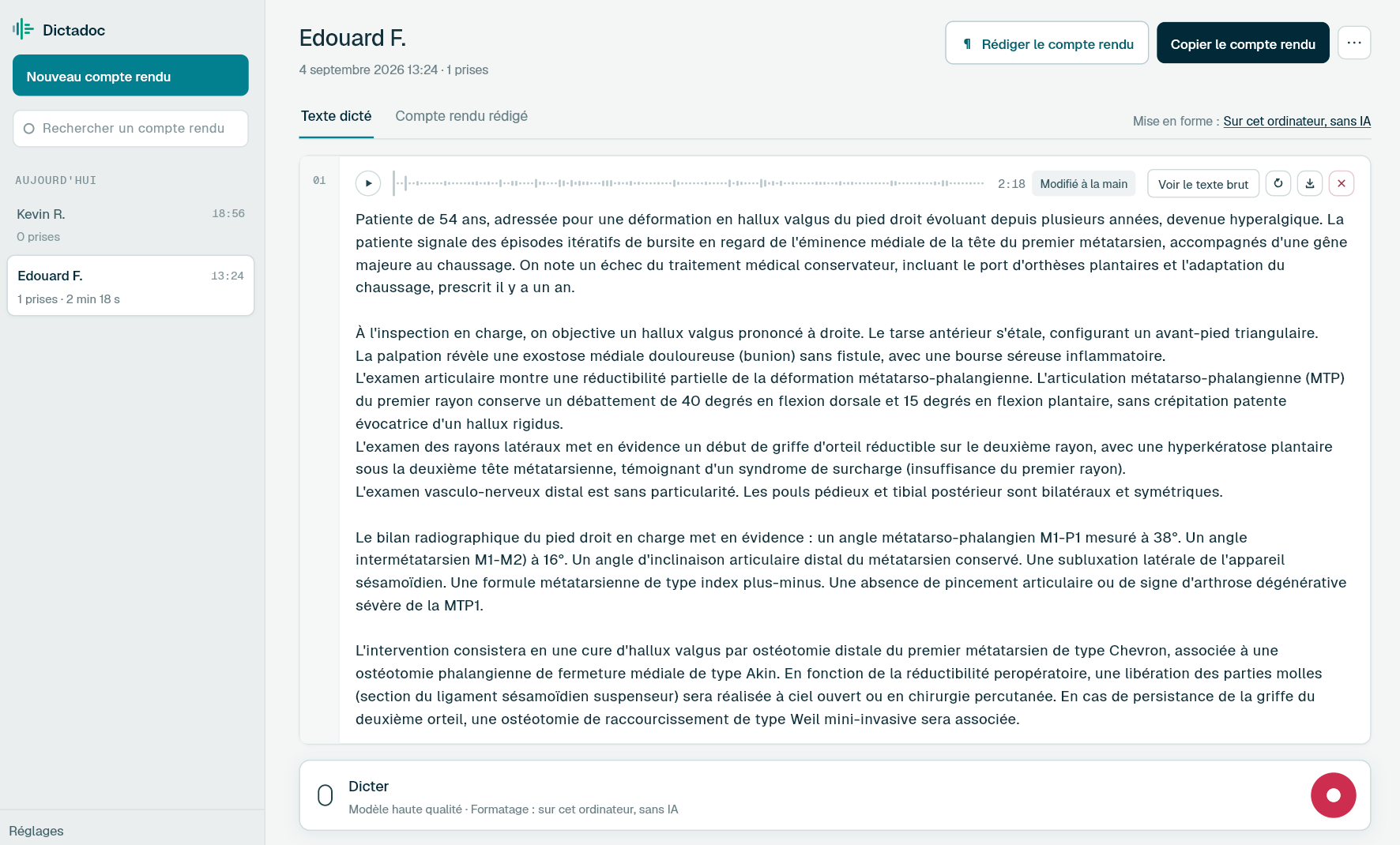
on examination [comma] asymmetrical akinetic-rigid syndrome worse on the right [full stop] cogwheel rigidity at the right wrist [comma] increased with contralateral activation [full stop] resting tremor of the right hand [comma] moderate amplitude [full stop][new line] walks unaided with reduced right arm swing [full stop] postural reflexes preserved [full stop][new paragraph] reflexes present and symmetrical [full stop] plantars flexor [full stop] eye movements normal [open parenthesis] in particular no vertical gaze palsy [close parenthesis][full stop][new paragraph] in summary [comma] right-sided parkinsonism in keeping with idiopathic Parkinson's disease [full stop] I have requested an MRI brain and suggested starting dopaminergic treatment [full stop]
What Dictadoc writes
On examination, asymmetrical akinetic-rigid syndrome worse on the right. Cogwheel rigidity at the right wrist, increased with contralateral activation. Resting tremor of the right hand, moderate amplitude.
Walks unaided with reduced right arm swing. Postural reflexes preserved.
Reflexes present and symmetrical. Plantars flexor. Eye movements normal (in particular no vertical gaze palsy).
In summary, right-sided parkinsonism in keeping with idiopathic Parkinson's disease. I have requested an MRI brain and suggested starting dopaminergic treatment.
The words in brackets are commands. Dictadoc replaces them with punctuation and line breaks.
The settings list every command for your language.
Privacy
What you dictate stays on your computer
Transcribed on your computer
Your computer transcribes your voice itself. Nothing you dictate is sent over the internet.
Erased on quit, if you want
Choose to keep nothing, and reports and recordings are erased when you quit Dictadoc.
Encrypted on your disk
The reports you keep stay in an encrypted database whose key is held by your system keychain.
For a clinic or hospital
Dictadoc Server transcribes for every workstation in your organisation, on a server on your premises. Nothing leaves your network.
It can happen. When a transcription gets stuck repeating one sentence three or more times, Dictadoc deletes the repeats and flags the take. The recording is untouched: run the transcription of that take again, with the same model or a more precise one, without dictating it a second time.
Are drug names and rating scales written correctly?
Dictadoc has no list of scales, and its drug lists cover French dictation only. It checks uncertain words against a general medical vocabulary, but an acronym, a drug or a rare name can still come out wrong. Add it to your vocabulary and it is spelled correctly from then on. A score stays in words, even with "Numbers, units and dosages" on, because that setting only handles numbers followed by a unit.
Can I dictate an EEG report while scrolling through the recording?
Yes. With the floating panel turned on, the dictation buttons stay visible above the EEG review software, and the keyboard keeps working in the recording. You page through while you talk. Dictadoc does not read the EEG: it transcribes what you say about it.
What happens to my dictation if the record is closed during a stroke call?
It is not lost. If you turned on text insertion, the text goes to the field that held your cursor. When that is not possible, because the window was closed for example, the text stays in the Dictadoc report and you are told.
Does the live preview work on any computer?
It needs a fast machine. With an NVIDIA graphics card, or on an Apple silicon Mac, transcription runs quickly. Without a graphics card it is 10 to 20 times slower, and the live preview asks for even more. If the machine cannot keep up, Dictadoc tells you, and the whole dictation is transcribed when you stop.
Install the app on Mac or Windows, buy a licence, then enter the key you receive by email in Dictadoc. The licence year starts on the day you activate it.
 Français
 English
 Deutsch
 Italiano
 Español