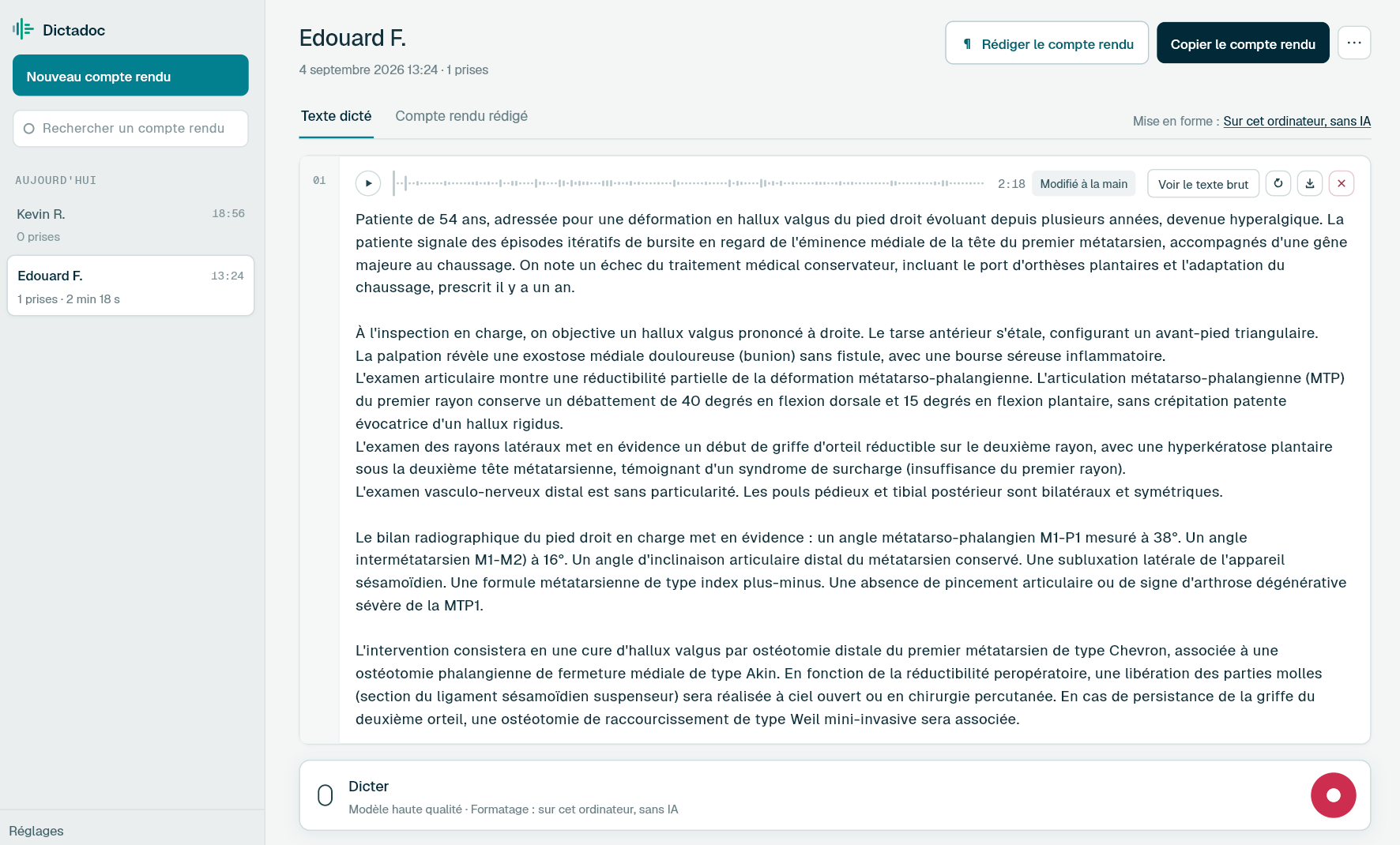
Dictate the macroscopic description, the microscopy and the conclusion. Dictadoc works on your computer, writes dimensions and weights as numbers if you turn it on, and also transcribes descriptions recorded on a dictaphone.
A single specimen goes through several stages, and each one leaves a text. Between the specimen arriving in the laboratory and the report being signed out, several days can pass.
The macroscopic description
Orientation, dimensions, weight, cut surface, distance to the margins and blocks taken. It is dictated specimen after specimen, and a margin distance noted wrongly carries right through to the conclusion.
The microscopic description and conclusion
Slide after slide: histological type, grade, extent, margin status. The conclusion is written for the surgeon or the oncologist, and it is often discussed again at the MDT meeting.
The frozen section
During the operation, a short answer goes to the surgeon, then has to be recorded in writing. It arrives in the middle of another case and interrupts it.
The supplementary report
When immunohistochemistry or molecular results come back, they are added to the original report. You have to find the case again and pick up where you left off, sometimes several days later.
Day to day
What holds up the pathology report
Reporting interrupted by a frozen section
Today
You are halfway through a microscopic description when a frozen section arrives, or a biomedical scientist comes to ask a question. When you come back, you reread what you already dictated to find your place, and sometimes you start again.
With Dictadoc
Pause the dictation, then resume it. A report can be dictated in several takes, and each one plays back: the end of the last take reminds you where you were. If a take is transcribed badly, run its transcription again with a more accurate model.
Dictation in several takes
Dimensions and weights written in words
Today
Cut-up is made of figures: specimen size, weight, lesion diameter, distance to each margin. An ordinary dictation tool writes some of them in words and others in digits, and every value gets checked before you sign.
With Dictadoc
Turn on "Numbers, units and dosages": "thirty-two grams" is then written "32 g" and "four millimetres from the deep margin" becomes "4 mm from the deep margin". Numbers dictated with no unit do not change, and Dictadoc neither corrects nor calculates any value.
Numbers, units and dosages
Cut-up recordings waiting to be typed
Today
At the cut-up bench, descriptions go onto a dictaphone. The files pile up until the secretaries type them, and until the macroscopy is entered, the report cannot move on.
With Dictadoc
Drop the dictaphone files onto a report: MP3, WMA, WAV and the other common audio formats go to transcription one after another. Each take can be read beside its audio, and a doubtful figure can be checked by ear.
Recording import
Dictation in several takes
Dictation example
A macroscopic description, specimen by specimen
Orientated wide local excision of the breast, described at the cut-up bench.
What you say
Wide local excision of the left breast orientated with a short suture superior and a long suture lateral [comma] weighing thirty-two grams and measuring sixty millimetres in maximum dimension [full stop] margins inked according to orientation [full stop][new paragraph] the cut surface shows a firm white stellate lesion [open parenthesis] fourteen millimetres [close parenthesis][full stop] it lies four millimetres from the deep margin [full stop] all other margins are more than ten millimetres clear [full stop][new paragraph] blocks [colon][new line] lesion and deep margin embedded in full [full stop][new line] remaining margins sampled adjacent to the lesion [full stop]
What Dictadoc writes
Wide local excision of the left breast orientated with a short suture superior and a long suture lateral, weighing 32 g and measuring 60 mm in maximum dimension. Margins inked according to orientation.
The cut surface shows a firm white stellate lesion (14 mm). It lies 4 mm from the deep margin. All other margins are more than 10 mm clear.
Blocks:
Lesion and deep margin embedded in full.
Remaining margins sampled adjacent to the lesion.
The words in brackets are commands. Dictadoc replaces them with punctuation and line breaks.
With the "Numbers, units and dosages" setting turned on.
The settings list every command for your language.
Privacy
What you dictate stays on your computer
Transcribed on your computer
Your computer transcribes your voice itself. Nothing you dictate is sent over the internet.
Erased on quit, if you want
Choose to keep nothing, and reports and recordings are erased when you quit Dictadoc.
Encrypted on your disk
The reports you keep stay in an encrypted database whose key is held by your system keychain.
For a clinic or hospital
Dictadoc Server transcribes for every workstation in your organisation, on a server on your premises. Nothing leaves your network.
It handles everyday medical language. When a word remains uncertain, Dictadoc compares it with a general medical list, and words heard clearly stay as they are. That list was not designed with pathology in mind: check histological types and marker names.
Can I keep the recording of a cut-up?
Yes. Each recording downloads as a WAV file, and a report exports as a ZIP archive that holds the audio and the text. You can listen to a description again weeks later, when the case comes back for discussion.
Can I dictate the macroscopy one day and the microscopy later?
Yes. Unless you choose otherwise, your reports stay on the computer in an encrypted database, listed by day with a search by title. Open the specimen's report when the slides are ready and dictate the rest in a new take. With "Erase everything on close", on the other hand, nothing is left from one day to the next.
Does Dictadoc connect to our laboratory information system?
No, there is no connector. With writing into the active application on, the transcribed text is typed into the report field where you left the cursor. If paste is refused, Dictadoc can enter the text one key at a time. When the text cannot be written, Dictadoc keeps it and lets you know.
Can the whole department dictate with Dictadoc?
Yes, in two ways. Each computer used for dictation can run Dictadoc, with its own licence. In a department where several pathologists dictate, Dictadoc Server can also transcribe for all those computers from a single machine in the laboratory.
Install the app on Mac or Windows, buy a licence, then enter the key you receive by email in Dictadoc. The licence year starts on the day you activate it.
 Français
 English
 Deutsch
 Italiano
 Español