Voice dictation for ENT 100% offline
Operative reports, audiograms, fibroscopies: speed up your daily practice.
Why is Dictadoc ideal for your specialty?
-
Targeted time savings
Free yourself from typing to focus on the clinical examination.
-
Expert vocabulary
Technical terms for head and neck anatomy.
-
Total security
No patient data leaves your computer. GDPR compliant and medical confidentiality. The application does not need internet to function.
Transparent Pricing
No hidden fees, no cost per minute, no nasty surprises. Just an affordable annual license to let you work with peace of mind.
- No commitment and no automatic renewal.
- Software updates included and free
- A free 3-day trial before you buy, no card required.
Annual License
- Unlimited dictation access
- Compatible Windows & MacOS
- 100% Local Processing
License purchase is done directly via our partner Stripe. You will receive an email containing an activation code to enter into Dictadoc.
The 1-year access to Dictadoc begins upon activation.
Important Information and Frequently Asked Questions
Does the text appear in real-time as I speak?
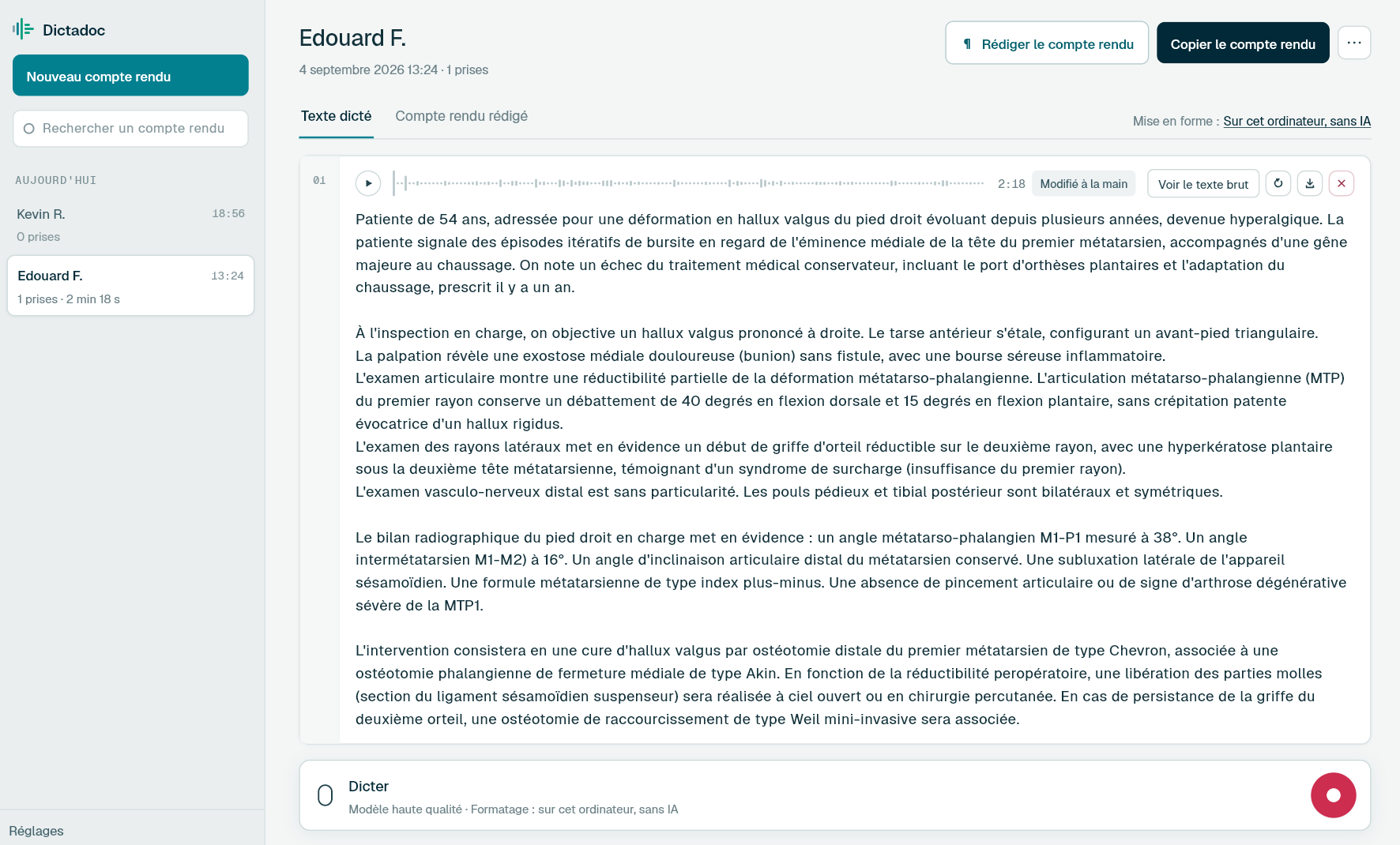
Yes, if you turn it on: the words appear a second or two behind your voice. It is a preview, not the report. As soon as you stop, your dictation is taken up again from the complete recording, and that pass is what guarantees superior medical precision: Dictadoc analyzes full portions of your sentence to understand the global clinical meaning and transcribe complex terms. The preview asks a lot of your machine, so it is off by default.
Does the app comply with GDPR?
Absolutely. Dictadoc was designed with "Privacy by Design". No audio data or text is sent over the internet. All processing takes place on your computer's processor.
Are my reports kept after I close the application?
By default, no: everything is erased when you close the application, then again at the next launch. You can turn retention on in the settings: your reports and your recordings are then kept on your computer in an encrypted database, whose key is entrusted to your system keychain. Uninstalling removes the database, the key and the downloaded models.
Can I get my recordings and my texts out?
Yes. Each recording downloads as a WAV file from its card, and a complete report exports as a ZIP archive containing the numbered audio files and, if you wish, the matching texts. The text on screen can also be copied to your patient file in one click.
Can I have recordings I already made transcribed?
Yes. Drop your files onto the report: they are transcribed one after another, like dictations recorded in the application. The common formats are accepted, MP3, M4A (AAC), WMA, FLAC, AIFF and WAV, because Dictadoc reads what your computer already knows how to read; the exact list therefore depends on your machine. A WAV file the recorder never closed properly, a flat battery or an interrupted transfer, is repaired as it is read rather than refused.
How do I find a report I dictated last week?
If you turned retention on, your reports stay in the list, grouped by day: today, yesterday, last week. Each row shows its number of takes and its total duration. A search by title sits just above it, and you do not have to worry about accents or capitals.
Can I dictate while my patient record software is on screen?
Yes. Turn the floating panel on in the settings: a small window stays on top and lets you start and stop dictation without leaving your practice software. It never takes keyboard focus, so your cursor stays where you left it. You choose when it appears: every time you switch to another application, or only during a dictation.
Can I start a dictation without leaving my patient software?
Yes. Turn the dictation key on in the settings and choose your combination: one press starts recording, the next sends the dictation to be transcribed. It answers even when Dictadoc is behind your practice software, so you no longer have to click in the floating panel. Turned off, the key goes back to your other applications.
Can the text be written straight into the patient record?
Yes, if you turn it on. At the end of each take, the text is typed into the field that had the cursor, as if you had typed it yourself. No integration and no connector are needed: it works with software installed on your computer as well as with a record open in your browser. You choose which window receives the text and whether it is laid out in paragraphs. Whatever happens, the dictation stays in the report: if the text cannot be written, a closed window or a password field for instance, Dictadoc tells you and you pick it up in the application.
Do I need a specific microphone?
It is preferable to have a good quality external microphone if you use Dictadoc during consultation. However, microphones built into recent MacBooks and laptops work very well.
Can I adapt the display to my screen and to my eyesight?
Yes. Choose the light theme, the dark theme, or the one your computer uses, and one of the three interface sizes: text, icons and spacing grow together, without the layout breaking. The window opens to fit your screen and remembers where you left it.
Does the software learn from my voice?
Dictadoc is "ready to use". It does not need a tedious learning phase and recognizes different accents and medical terminology from the very first use.
Can I try Dictadoc before buying?
Yes. Download the application: the welcome screen offers a free 3-day trial, with no card and with every feature. Starting the trial goes through our server once, like activating a licence, and there is one trial per computer. If you do not buy, there is nothing to cancel: the trial stops on its own.
Can I use it on multiple computers?
The license is linked to a single installation. To use Dictadoc on multiple computers, you will need multiple independent licenses. Please note, licenses cannot be transferred between computers. Once activated, the license key is stored locally on your computer and cannot be moved.
Do I need a powerful computer for transcription to be fast?
Since Dictadoc works 100% locally for your security, speed depends on your hardware:
- On Mac: The app is universal: it runs on Apple Silicon Macs and on Intel Macs. The experience is optimal on models equipped with Apple Silicon chips (M1, M2, M3, M4, M5): transcription runs on their graphics processor through Metal, which makes it very fast. On an Intel Mac, the main processor handles the work and it takes longer.
- On Windows: If you have a dedicated graphics card (NVIDIA) with CUDA or an Intel Core Ultra CPU, processing will be fast. On a standard desktop PC (without a graphics card), the software will use the main processor (CPU): this works perfectly, but processing will be much slower once recording is finished. The absence of a graphics card increases generation time by 10 to 20x.
How do I hear about new versions?
At launch, Dictadoc tells you when a more recent version is available and points you to the download page. It never installs anything on its own. Updates are included in your license.