Dictate the comprehensive geriatric assessment over the day and the discharge letter before the patient goes home or to a care home. Dictadoc transcribes on your computer, keeps every part in the same report and, once that setting is on, writes weight, albumin and doses as numbers.
An older patient often moves between several care settings in a few weeks. Each move needs a document that tells the next team what has changed.
The comprehensive geriatric assessment
Function, cognition, mood, nutrition, falls risk, medication and social situation. It is done in stages, often over half a day in the day hospital, and the report covers each part before the summary.
The discharge letter
For the GP, the rehabilitation team or the care home. It says what changed during the stay: medicines stopped or changed, weight, mobility, instructions. Its date often depends on a bed or a care package becoming available elsewhere.
The memory clinic letter
The difficulties described by the patient and their family, the examination, the cognitive tests and the conclusion. The assessment spans several appointments, and the final letter brings them together for the GP.
The liaison opinion
An opinion given in the emergency department or on another ward, after a fall or an episode of delirium. A few paragraphs in the notes of the team who asked, written before you move on to the next patient.
Day to day
What delays your letters in geriatric medicine
An assessment done in stages
Today
The history is taken in the morning, the cognitive tests late in the morning and the call to the family in the afternoon. Between two parts, the ward bleeps you about another patient. The report gets written in the evening, from scattered notes.
With Dictadoc
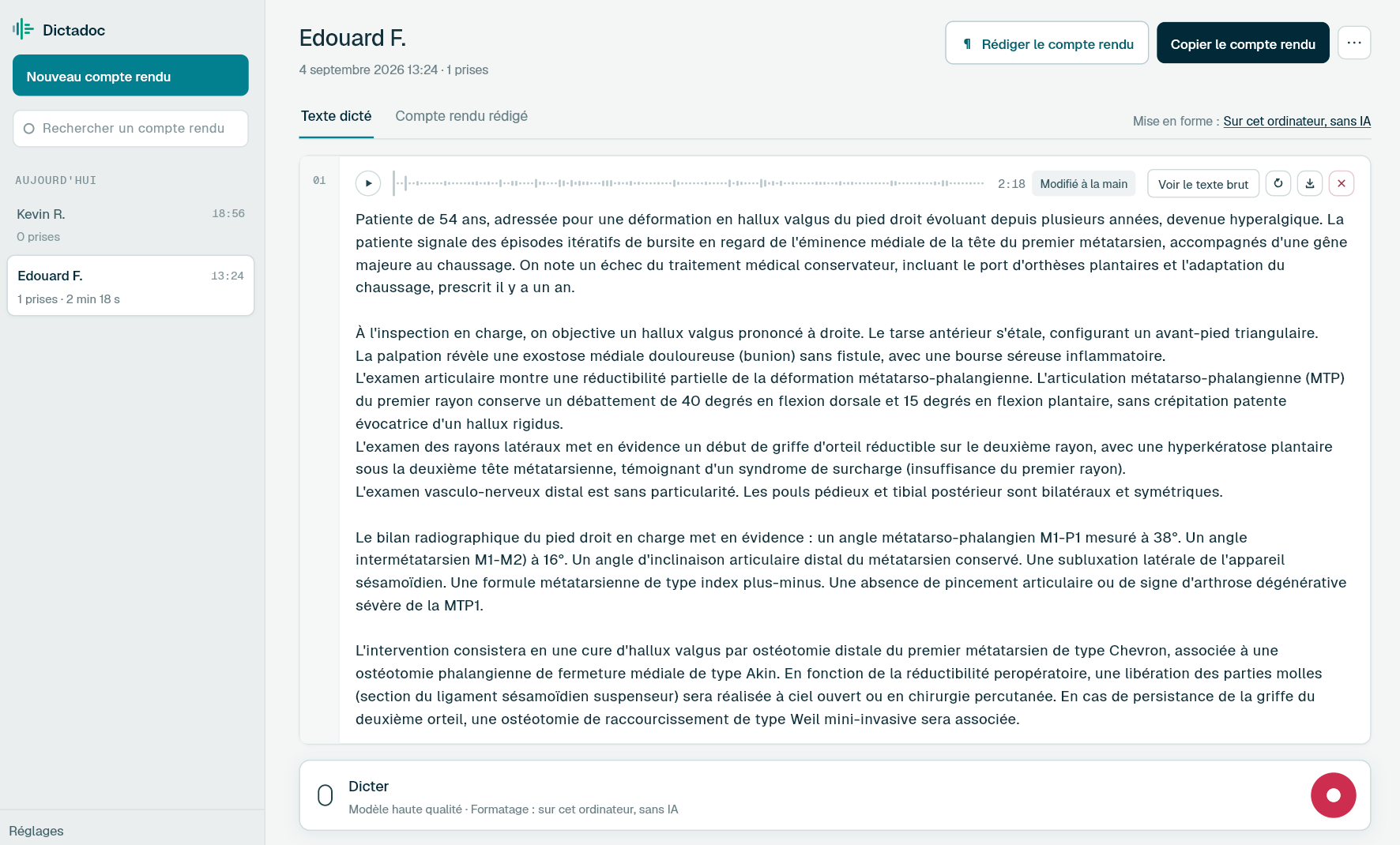
Dictate each part into the same report as soon as you finish it. If the ward calls, pause the dictation and pick it up when you are back. Each take plays back beside its text, and a take that came out badly can go through transcription again with a more accurate model.
Dictation in several takes
Discharge delayed, a letter to find again
Today
The letter is ready for discharge on Tuesday. The care home bed only becomes free the following week, and in the meantime a medicine has changed, and so has the weight. You have to find the text again, or dictate it all over.
With Dictadoc
Unless you choose otherwise, reports stay saved in a list grouped by day. Type a few letters of the title to find the letter, correct what changed by hand or dictate one more take, then copy it.
Report library
Dictation in several takes
Weight, albumin and doses in words
Today
A letter in geriatric medicine is full of figures: weight, albumin, renal function, reduced doses. Depending on the dictation tool, they come out in words or in digits, and each one gets checked when you read the letter through.
With Dictadoc
In the settings, turn on "Numbers, units and dosages". "Forty-nine kilograms" is then written "49 kg", "thirty-one grams per litre" becomes "31 g/L" and "three times a week" becomes "3 times a week". Dictadoc writes the figures you dictate and calculates none of them.
Numbers, units and dosages
Dictation example
A discharge letter to a care home
Return to a care home after an admission for a fall.
What you say
Admitted after a fall with a long lie [full stop] no fracture [comma] mild rhabdomyolysis treated with intravenous fluids [full stop][new paragraph] nutrition [colon] weight forty-nine kilograms [comma] down five kilograms over six months [full stop] albumin thirty-one grams per litre [full stop] oral nutritional supplements twice daily [full stop][new paragraph] medication changes [colon][new line] zopiclone stopped [open parenthesis] likely to have contributed to the fall [close parenthesis][full stop][new line] furosemide reduced to twenty milligrams once daily [full stop][new paragraph] mobilising with a walking frame and the assistance of one [full stop] physiotherapy to continue three times a week [full stop]
What Dictadoc writes
Admitted after a fall with a long lie. No fracture, mild rhabdomyolysis treated with intravenous fluids.
Nutrition: weight 49 kg, down 5 kg over six months. Albumin 31 g/L. Oral nutritional supplements twice daily.
Medication changes:
Zopiclone stopped (likely to have contributed to the fall).
Furosemide reduced to 20 mg once daily.
Mobilising with a walking frame and the assistance of one. Physiotherapy to continue 3 times a week.
The words in brackets are commands. Dictadoc replaces them with punctuation and line breaks.
With the "Numbers, units and dosages" setting turned on.
The settings list every command for your language.
Privacy
What you dictate stays on your computer
Transcribed on your computer
Your computer transcribes your voice itself. Nothing you dictate is sent over the internet.
Erased on quit, if you want
Choose to keep nothing, and reports and recordings are erased when you quit Dictadoc.
Encrypted on your disk
The reports you keep stay in an encrypted database whose key is held by your system keychain.
For a clinic or hospital
Dictadoc Server transcribes for every workstation in your organisation, on a server on your premises. Nothing leaves your network.
Can Dictadoc transcribe the conversation with the family?
No. Dictadoc transcribes your dictation, not a conversation between several people, and it draws no notes from a discussion. Once the meeting is over, dictate what the family told you and what was decided.
Does Dictadoc calculate a score or a creatinine clearance?
No. It calculates no score, no clearance and no dose, and you read everything through: Dictadoc is not a medical device. With "Numbers, units and dosages" on, a clearance dictated as "forty-two millilitres per minute" is written "42 mL/min". A test score dictated with no unit, such as "twenty-four out of thirty", stays in words.
How does the discharge letter reach the care home?
Dictadoc sends nothing: it has no messaging and no connector. Copy the letter into Word or an email, where it keeps its paragraphs. If you turn it on, the text can also be written straight into the record, where you clicked. It then goes out the way your hospital usually sends letters.
Are the reports for a readmitted patient grouped together?
No. Kept reports are grouped by day, and the search looks at titles, not at the text. Use the same words in the title of every report for one patient, and a search on those words shows them together.
Our ward computers are old. Will Dictadoc be fast enough?
That depends on the machine, because transcription runs on it. Macs with Apple silicon and PCs with an NVIDIA graphics card transcribe quickly. An old computer with only its processor takes 10 to 20 times longer: choose the fastest of the three models in the settings.
Install the app on Mac or Windows, buy a licence, then enter the key you receive by email in Dictadoc. The licence year starts on the day you activate it.
 Français
 English
 Deutsch
 Italiano
 Español