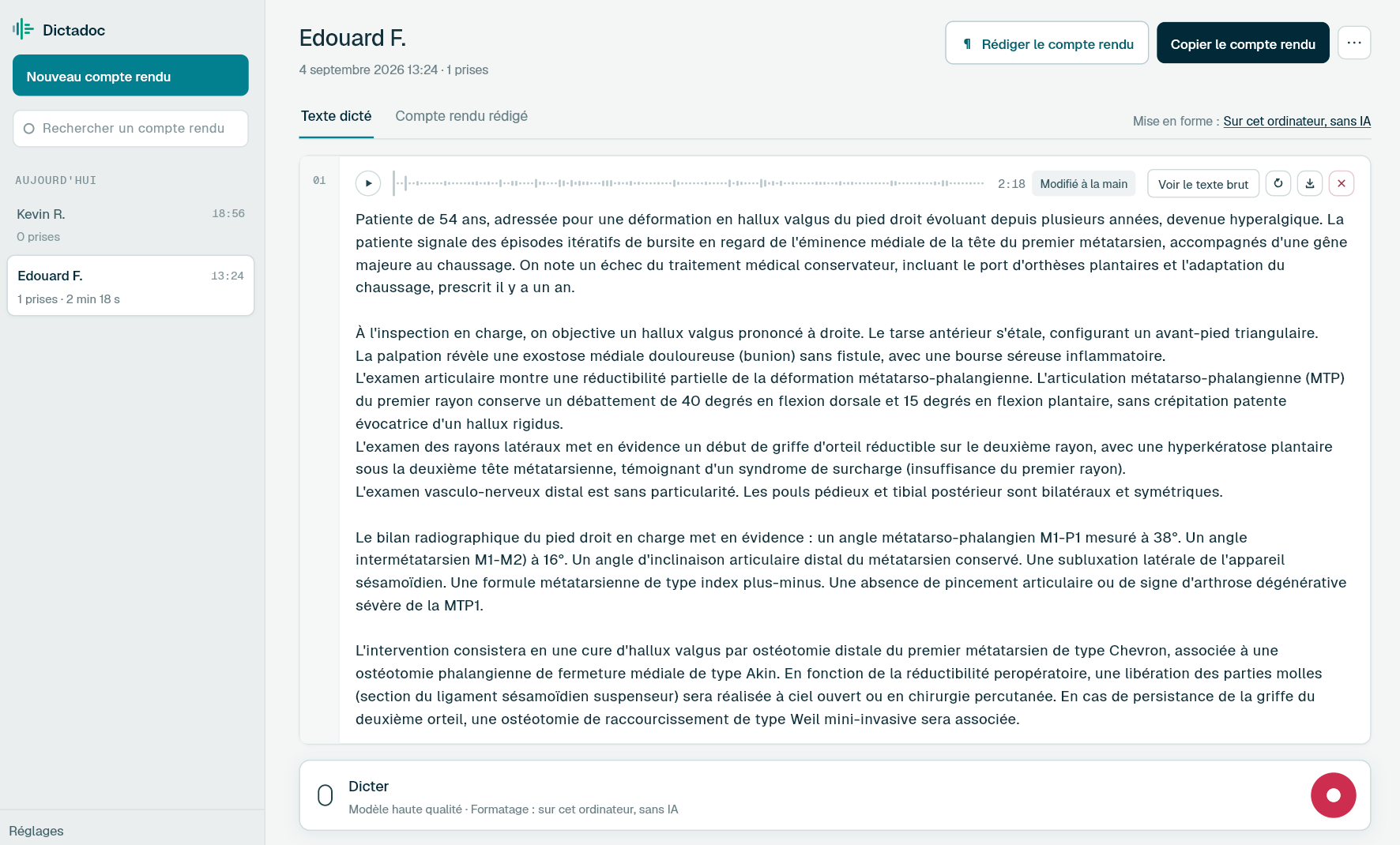
Dictate the operation note between cases and the clinic letter while the patient is still in the room. Dictadoc transcribes on your computer, checks the anatomical terms it was unsure of and can type the text straight into your patient record.
A day split between theatre and clinic produces several kinds of document. Each one has its moment, and none of them can wait long.
The operation note
Position, approach, findings, procedure, implants and closure, then the instructions for the ward. The team caring for the patient works from it, so it gets written between cases or at the end of the list.
The clinic letter
History, examination, imaging and the plan, addressed to the GP and often copied to the patient. Every patient seen needs one, and a busy fracture clinic or elective clinic leaves a long list to write.
Follow-up letters
Wound, range of movement, weight bearing and physiotherapy. Short letters, but a lot of them, at each stage after a joint replacement or a fracture.
The procedure note
Joint injection, aspiration or arthroscopy: a few lines on what was done, the drug, the dose and the aftercare, done before the next patient is called in.
Day to day
What holds your notes and letters up
Anatomical terms transcribed wrongly
Today
General speech recognition writes "sin desmosis" for syndesmosis or "hollow valgus" for hallux valgus. Every note has to be read word by word, and the corrections eat up the time dictation was supposed to save.
With Dictadoc
Dictadoc picks out the words it was unsure of and compares them with a medical vocabulary built first around the foot and ankle, knee, hip, spine and shoulder. "Sin desmosis" goes back to "syndesmosis". Words it heard clearly are never changed.
Medical vocabulary check
The letter waits until clinic is over
Today
Between patients there is no time to type up the examination. Letters are left for the evening, or go to the secretaries as recordings and come back typed a few days later.
With Dictadoc
Switch on both the dictation key and text insertion. With the patient record open, press the key, describe the examination, then press once more. The text lands in the field your cursor was in, and the letter is done before the next patient comes in.
Dictation key
Text typed into the field
Dictaphone recordings pile up
Today
You already dictate operation notes on a pocket dictaphone or on your phone. The files wait to be typed, sometimes for days, and a typing error on a side or a spinal level only shows up when you proofread.
With Dictadoc
Drop the recordings onto a report. MP3, M4A, WMA, FLAC, AIFF and WAV are accepted, depending on what your computer can read, and they are transcribed in turn. You read each take next to its audio, and a doubtful passage plays back in one click.
Recording import
Dictation in several takes
Dictation example
An operation note, dictated between two cases
A total knee replacement, dictated before going back in for the next case.
What you say
patient supine [comma] high thigh tourniquet inflated to three hundred millimetres of mercury [full stop] cefuroxime one point five grams and tranexamic acid one gram at induction [full stop][new paragraph] medial parapatellar approach through a twelve centimetre midline incision [full stop] partial synovectomy and removal of osteophytes [full stop][new line] cemented posterior stabilised total knee replacement [comma] stable and well balanced in flexion and extension [full stop] patella not resurfaced [full stop][new paragraph] closure in layers over a drain [full stop] local anaesthetic infiltration [full stop] compression bandage [full stop]
What Dictadoc writes
Patient supine, high thigh tourniquet inflated to 300 mmHg. Cefuroxime 1.5 g and tranexamic acid 1 g at induction.
Medial parapatellar approach through a 12 cm midline incision. Partial synovectomy and removal of osteophytes.
Cemented posterior stabilised total knee replacement, stable and well balanced in flexion and extension. Patella not resurfaced.
Closure in layers over a drain. Local anaesthetic infiltration. Compression bandage.
The words in brackets are commands. Dictadoc replaces them with punctuation and line breaks.
With the "Numbers, units and dosages" setting turned on.
The settings list every command for your language.
Privacy
What you dictate stays on your computer
Transcribed on your computer
Your computer transcribes your voice itself. Nothing you dictate is sent over the internet.
Erased on quit, if you want
Choose to keep nothing, and reports and recordings are erased when you quit Dictadoc.
Encrypted on your disk
The reports you keep stay in an encrypted database whose key is held by your system keychain.
For a clinic or hospital
Dictadoc Server transcribes for every workstation in your organisation, on a server on your premises. Nothing leaves your network.
It transcribes everyday medical language, and its correction list was written for your field first: the foot and ankle, the knee, the hip and spine, the shoulder and upper limb, then bone and soft tissue. An implant or a technique it gets wrong can go into your own vocabulary with a right-click in the report.
Can I dictate an operation note in several goes?
Yes. Dictate it in several takes: pause when you are called away, then carry on. Each take can be played back, corrected by hand or transcribed again with another model.
Can the text go straight into the hospital's software?
Yes, once you turn it on. A key starts dictation from any application, and the text goes into whichever field holds the cursor, with no connector. Where a program will not accept pasting, Dictadoc types the text key by key. The report also stays in Dictadoc, and if the text cannot be written, you get a message.
Are doses and measurements written as numbers?
Yes, once the "Numbers, units and dosages" setting is active. Numbers followed by their unit turn into digits: "two grams" becomes "2 g" and "twelve centimetres" becomes "12 cm". Degrees of joint movement and implant sizes stay in words.
Do I need a powerful computer?
Transcription happens on your own machine, so the machine sets the pace. It runs fast on Apple silicon Macs and on PCs with an NVIDIA graphics card, and 10 to 20 times slower when only the processor does the work. Where several surgeons in one hospital dictate, Dictadoc Server can transcribe for all their workstations from a single computer.
Install the app on Mac or Windows, buy a licence, then enter the key you receive by email in Dictadoc. The licence year starts on the day you activate it.
 Français
 English
 Deutsch
 Italiano
 Español