Clinical cardiology and non-invasive investigations
Voice dictation for cardiologists
Dictate the echo report as you go through the measurements, and the letter before the next patient comes in. Transcription happens on your computer, measurements can be written in digits and the text can go straight into your patient record.
Clinics and investigations share the same day. Each test leaves a report behind, and someone is usually waiting for it.
The echocardiogram report
Left ventricular size and function, valves, atria, filling pressures and pericardium. Many values read off the echo machine, for a report the patient or the referring doctor expects the same day.
The exercise tolerance test report
Protocol, stage reached, peak heart rate, blood pressure response, symptoms and ECG changes. It gets written straight after the test, while the room is being made ready for the next patient.
The Holter report
A 24-hour ECG or blood pressure monitor, fitted the day before and reported once the recording has been analysed. Reports build up and often get dictated in a row, each with a short conclusion that has to be exactly right.
The letter to the GP
The reason for referral, examination, ECG, investigations and any change in medication. One letter per patient, with a plan the GP can follow without having to phone you.
Day to day
Where your reports fall behind
Measurements to copy into every report
Today
Diameters, wall thickness, ejection fraction, gradients and pulmonary pressure: the echo report fills with values read off the machine's screen. Typed between patients, they are exactly where a typo slips through.
With Dictadoc
With "Numbers, units and dosages" on, "forty-nine millimetres" is written "49 mm", "sixty percent" is written "60%" and "thirty-two millimetres of mercury" is written "32 mmHg". Beats per minute stay in words. Read every value before you send the report.
Numbers, units and dosages
The report waits to be typed into the record
Today
Values get jotted down at the end of the scan, then the report is typed into the record when clinic allows. Otherwise it goes to the secretaries as a recording and comes back for checking the next day, when the scan is no longer fresh in your mind.
With Dictadoc
Enable the dictation key along with text insertion. Put the cursor in the report field of the record, press the key, dictate and press it again. The text is written at the cursor, with no connector. If the window was closed in the meantime, Dictadoc keeps the text and shows a message.
Text typed into the field
Dictation key
Dictating without seeing what gets written
Today
You dictate the echo with your eyes on the machine's measurements, or a batch of Holters at the end of the day. Nothing shows until you stop, so a value misheard early on only turns up when you proofread, and then you have to find the passage.
With Dictadoc
Turn on the live preview: your words show up in Dictadoc, trailing a second or two after you speak. It is only a preview, because the text you keep is transcribed again from the whole recording when you stop. A doubtful passage can be replayed in its take and corrected by hand. Expect the preview to demand a lot from the computer.
Live text
Dictation in several takes
Dictation example
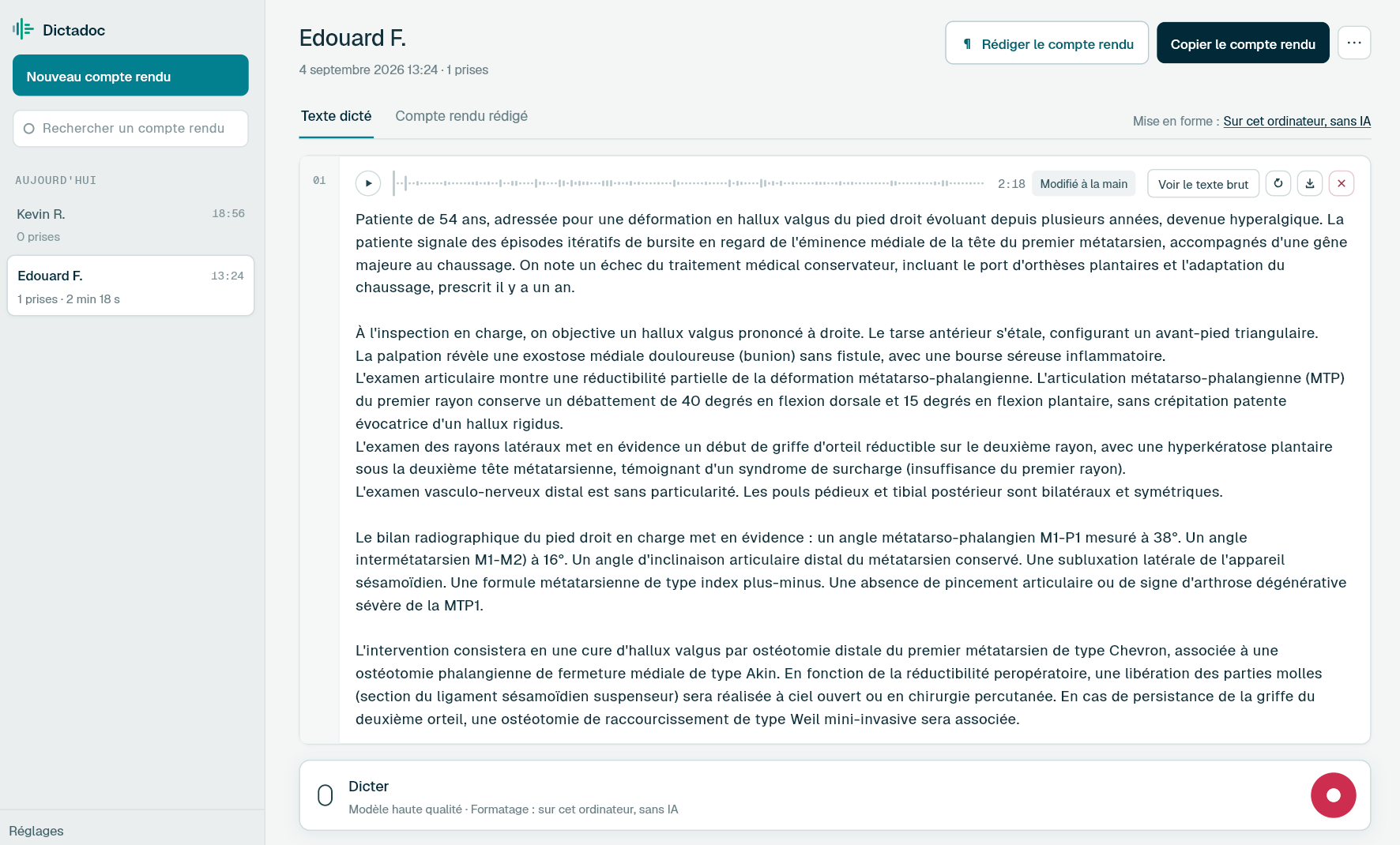
An echocardiogram report, dictated after the scan
Follow-up transthoracic echocardiogram in a patient with hypertension.
What you say
left ventricle not dilated [comma] end-diastolic diameter forty-nine millimetres [full stop] moderate concentric hypertrophy [comma] interventricular septum fifteen millimetres [full stop] ejection fraction estimated at sixty percent by biplane Simpson's [full stop][new paragraph] left atrium moderately dilated [full stop] mitral inflow pattern shows impaired relaxation [full stop][new line] trileaflet aortic valve [comma] no stenosis [full stop] trivial mitral regurgitation [full stop][new paragraph] inferior vena cava not dilated with normal respiratory variation [full stop] estimated pulmonary artery systolic pressure thirty-two millimetres of mercury [full stop] no pericardial effusion [full stop]
What Dictadoc writes
Left ventricle not dilated, end-diastolic diameter 49 mm. Moderate concentric hypertrophy, interventricular septum 15 mm. Ejection fraction estimated at 60% by biplane Simpson's.
Left atrium moderately dilated. Mitral inflow pattern shows impaired relaxation.
Trileaflet aortic valve, no stenosis. Trivial mitral regurgitation.
Inferior vena cava not dilated with normal respiratory variation. Estimated pulmonary artery systolic pressure 32 mmHg. No pericardial effusion.
The words in brackets are commands. Dictadoc replaces them with punctuation and line breaks.
With the "Numbers, units and dosages" setting turned on.
The settings list every command for your language.
Privacy
What you dictate stays on your computer
Transcribed on your computer
Your computer transcribes your voice itself. Nothing you dictate is sent over the internet.
Erased on quit, if you want
Choose to keep nothing, and reports and recordings are erased when you quit Dictadoc.
Encrypted on your disk
The reports you keep stay in an encrypted database whose key is held by your system keychain.
For a clinic or hospital
Dictadoc Server transcribes for every workstation in your organisation, on a server on your premises. Nothing leaves your network.
Transcription covers common medical vocabulary. An uncertain term is then matched against a general medical vocabulary, with no list specific to echocardiography. A word it keeps getting wrong goes into your vocabulary with a right-click in the report, and it comes out right in the dictations that follow. Dictadoc's cardiology drug list applies to French dictation only.
Are exercise test values written in digits too?
Partly. Once you enable "Numbers, units and dosages", millimetres of mercury and percentages become digits: "one hundred and sixty millimetres of mercury" becomes "160 mmHg". Heart rate in beats per minute, watts and METs stay in words, like any number said without a unit.
Does Dictadoc read the measurements from the echo machine?
No. Dictadoc is not connected to any device: it reads neither the echo measurements nor the traces, and you dictate them as you read them on screen. The text can then be written into the report in your record. If your software blocks pasting, set Dictadoc to type the text key by key.
Does Dictadoc check a measurement or a dose?
No. It does not compare a measurement with normal values, works nothing out and checks no dose, since Dictadoc is not a medical device. Read the report through before you send it.
Do I need a licence for each echo room?
Yes, one for each computer you dictate on: a licence cannot move from one computer to another. In a group practice or a hospital cardiology department, Dictadoc Server can also transcribe the dictations from every room on a single computer.
Install the app on Mac or Windows, buy a licence, then enter the key you receive by email in Dictadoc. The licence year starts on the day you activate it.
 Français
 English
 Deutsch
 Italiano
 Español